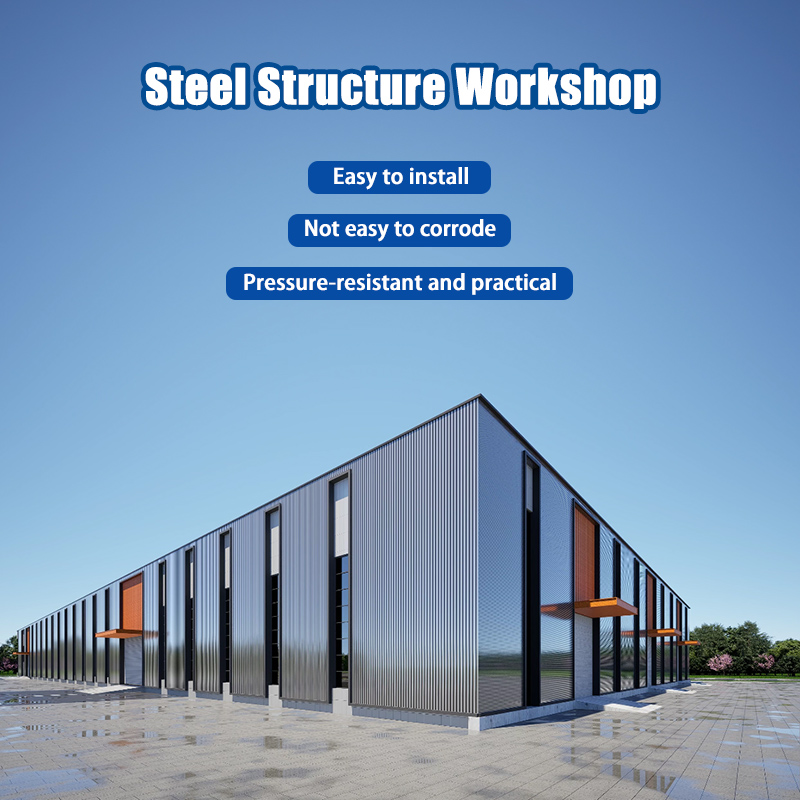
In industrial production, large-scale storage, and heavy equipment installation scenarios, traditional concrete factories often encounter “long construction period, insufficient load-bearing capacity, and difficult renovation” problems, which seriously affect the production efficiency and long-term development of enterprises. Our steel structure factory breaks through these limitations from four dimensions: construction period, load-bearing capacity, environmental protection, and flexibility, with core advantages precisely matching the requirements of modern industrial buildings:
- Ultra-fast construction and delivery, with a 50%+ reduction in construction period. Using the “90% factory prefabrication + on-site assembly” model, steel components (steel beams, steel columns, roof trusses) are standardized produced in the factory, reducing on-site pouring, curing, etc. For a 10,000㎡ single-story factory, traditional concrete requires 120-150 days, while the steel structure can be completed in 60-80 days; for multi-story factories (3-5 floors), the construction period can be compressed to 90-120 days. A professional installation team is equipped, using the “bolt connection + segmented hoisting” process, unaffected by rainy or winter seasons, and construction can be carried out throughout the year. This enables enterprises to start production 3-6 months earlier, accelerating capital recovery.
2. High load-bearing capacity + large span, suitable for heavy equipment requirements
The core uses Q355B high-strength steel (yield strength 355MPa), combined with “H-shaped steel beams + box steel columns”, with a single-span span of 30m without columns (traditional concrete’s maximum single-span is only 15m), facilitating the layout and entry of heavy equipment (such as machine tools, cranes). The floor load-bearing capacity can reach 5t/㎡ (traditional concrete factories usually 2-3t/㎡), and the roof can bear 1.2kN/㎡ (suitable for photovoltaic panel installation, large ventilation equipment installation), meeting high-strength usage scenarios such as mechanical processing, automotive manufacturing, and heavy storage.
3. Environmentally friendly and durable, with lower long-term costs
The steel recovery rate is over 90% (the recovery rate of concrete materials is less than 30%), and construction waste is reduced by 70% during demolition. It complies with the national “carbon neutrality” policy and green building standards, and in some regions, environmental subsidies can be applied for. The steel components’ surface is treated with “galvanizing + anti-corrosion coating”, enhancing rust and corrosion resistance, with a lifespan of over 50 years (traditional concrete factories usually 30-40 years); the roof uses “color steel sandwich panels + waterproof membranes”, with a waterproof grade of IPX7, and the wall has a wind-breaking performance of 12 grades, suitable for complex climate regions such as coastal and windy areas.
4. Flexible renovation, suitable for enterprise growth
The steel structure factory supports “late expansion + functional renovation”: if the area needs to be expanded, it can be directly connected to the original steel frame (no need for demolition and reconstruction), with a renovation cycle shortened to 30-45 days; if the load-bearing needs to be adjusted (such as adding heavy equipment), only the local steel beams and columns need to be reinforced, with costs reduced by 60% compared to the renovation of traditional concrete factories. The internal space has no load-bearing walls restrictions, and can be flexibly divided into workshops, warehouses, and office areas according to production needs, with column spacings customizable from 6-12m, increasing space utilization by 25% compared to traditional factories.
In addition, the factory has passed ISO 9001 quality certification and CE certification, with a fire protection grade of A (wall uses fire-resistant rock wool sandwich panels, with a fire resistance limit of ≥2 hours), meeting the industrial building specifications of both domestic and foreign countries; it can be designed with crane beams, unloading platforms, photovoltaic brackets, etc., achieving “one-stop customization” and avoiding secondary construction in the future.